Cart
0
Quick Summary
To verify authentic gold jewelry online, check the listing before you pay: look for a stated karat such as 14K, confirm whether the piece is solid gold, gold filled or gold plated, and confirm the seller is a real, reachable business. Then inspect the piece on arrival for a crisp hallmark that matches the listing.
- Look for a karat stamp such as 10K, 14K, 18K or 24K on solid gold pieces.
- Avoid listings described only as gold tone, gold look or gold-colored.
- Confirm the seller publishes a physical business address and a working phone number.
- Photograph the package and hallmarks before wearing the piece, to protect your return rights.
- Home tests only screen for obvious fakes; a jeweler's XRF reading gives the reliable check.
Want gold jewelry you can check?Sheweetie.com lists each piece's metal and construction so you know what you are buying.
Shop Verified Gold Jewelry
Table of Contents
- Why Verifying Gold Jewelry Before You Buy Online Matters
- Gold Jewelry Hallmarks and Stamps: What the Markings Really Tell You
- Solid Gold vs Gold Plated vs Gold Filled: Reading Online Listings Correctly
- Step 1: Vet the Seller and Product Listing Before You Order
- Questions to Ask When Buying Gold Jewelry Online
- Step 2: Test the Piece Safely After Delivery
- How Jewelers Test Gold and When to Ask for a Professional Check
- Your Next Step: Ordering a Piece You Can Verify Yourself
- Frequently Asked Questions
Why Verifying Gold Jewelry Before You Buy Online Matters
Last Updated: November 8, 2026
Buying gold jewelry online means you cannot touch, weigh or inspect the piece before it arrives, so knowing how to verify authentic gold jewelry online starts before you pay.
Gold is valuable, and that value attracts fakes. Plated and filled pieces can look similar to solid gold in photos. Knowing the difference saves money and disappointment.
What we'll cover:
- How to read hallmarks and purity stamps
- What "solid gold," "gold plated" and "gold filled" really mean
- How to vet a seller before you order
Keep in mind that most DIY tests have limits. The goal is to rule out obvious fakes, not to prove purity with certainty.
Gold Jewelry Hallmarks and Stamps: What the Markings Really Tell You
A hallmark is a stamp that shows the metal's purity. In the United States, solid gold is marked with karat numbers such as 10K, 14K, 18K or 24K (Buying Platinum, Gold, and Silver Jewelry). A stamp like "14K" means the piece is about 58.3% gold by weight.
Hallmarks are useful, but they can be faked. Look for these details:
- Clear, crisp markings: Stamps that look blurry or shallow can be a warning sign.
- Matching numbers: Stamps should appear on the clasp, bail or inside the band, not just on the packaging.
- Other marks: Some pieces carry a maker's mark or trademark, which you can check against the company.
Remember that a stamp only states what the maker claims. Pair it with seller research before you trust it.
Solid Gold vs Gold Plated vs Gold Filled: Reading Online Listings Correctly
Online listings often use these terms loosely. Here is what they mean:
- Solid gold: Gold runs through the entire piece. It carries a karat stamp like 14K.
- Gold filled: A thick layer of gold is bonded over a base metal. Gold filled pieces carry a thick layer of gold over a base metal, so they generally wear longer than plated ones.
- Gold plated: A very thin layer of gold is coated over a base metal. It wears away faster, sometimes within months.
Our 14K Gold Filled PLUS™ 2.5MM Paperclip Chain Necklace is a good example of a gold filled piece. It uses warm 14K gold bonded over a stainless steel core, so it is not solid gold.
Watch out: a listing that says "gold tone," "gold look" or "gold-colored" usually means no real gold at all.
Step 1: Vet the Seller and Product Listing Before You Order
Many guides to gold authenticity start after the package arrives. That is too late to protect your money. The strongest defense is a ten-minute review of the seller and the listing before checkout, because a return window is far easier to use than a chargeback.
Confirm the seller is a real, reachable business
A legitimate retailer publishes a physical business address, a working phone number, and a customer-service email. Check that the domain has a real "About" and "Contact" page, not just a contact form. Search the business name plus "reviews" and "complaints" on independent sites, and look at the seller's marketplace profile if you are buying through a platform.
Watch out: a seller who will not state a business address or who answers material questions only through direct messages is a risk you cannot underwrite.
Read the listing for the exact metal, karat, and construction
Many guides focus on the stamp, but the listing itself should also state what it is made of. A trustworthy listing names the metal (for example, 14K gold), the construction (solid, gold filled, gold plated, or vermeil), the base metal under any coating, and the approximate weight or gram weight where relevant. Vague phrases such as "gold jewelry," "gold finish," or "gold tone" are not descriptions; they are marketing.
Interpret the terminology before you pay
These terms are not interchangeable, and the difference determines what you are buying:
- Solid gold: A gold alloy throughout the piece, stamped with a karat such as 10K, 14K, 18K, or 24K. A karat stamp indicates the proportion of gold in the alloy.
- Gold filled: A thick layer of gold mechanically bonded to a base metal. A gold filled piece has a thick layer of gold bonded over a base metal, which is why it generally outlasts a plated piece.
- Gold plated: A very thin gold coating over a base metal such as brass, copper, or sterling silver. The coating can wear through with regular wear.
Request documentation and know what it proves
Ask the seller for close-up photos of the hallmark, the clasp, and the inside of the band, plus any certificate or test report they hold. A certificate from an independent lab carries more weight than a branded card printed by the seller, but neither proves the specific piece in the box is the item tested. Treat documents as evidence of what the seller claims, not as proof of purity.
Check returns, payment protection, and marketplace policy
Before you pay, confirm the return window in days, who pays return shipping, and whether the policy excludes items that have been worn or altered. Pay with a method that offers dispute rights, such as a major credit card, rather than a wire transfer or peer-to-peer payment app. If you buy through a marketplace, read its buyer-protection policy and note the deadline for opening a claim.
Questions to Ask When Buying Gold Jewelry Online
Before you order, ask the seller these questions. A reputable retailer will answer them clearly.
- What exact metal and karat is the piece made from?
- Is it solid gold, gold filled or gold plated?
- What is the base metal under the gold layer?
- Is there a hallmark or stamp, and where is it located?
Save written answers and screenshots. They help if a dispute comes up later.
Step 2: Test the Piece Safely After Delivery
Home tests are often described in isolation. The safer approach is a sequence that preserves your evidence and your return rights while you verify. Work in good light, keep the original packaging and tags, and do not wear the piece until you are satisfied.
Document the package and item first
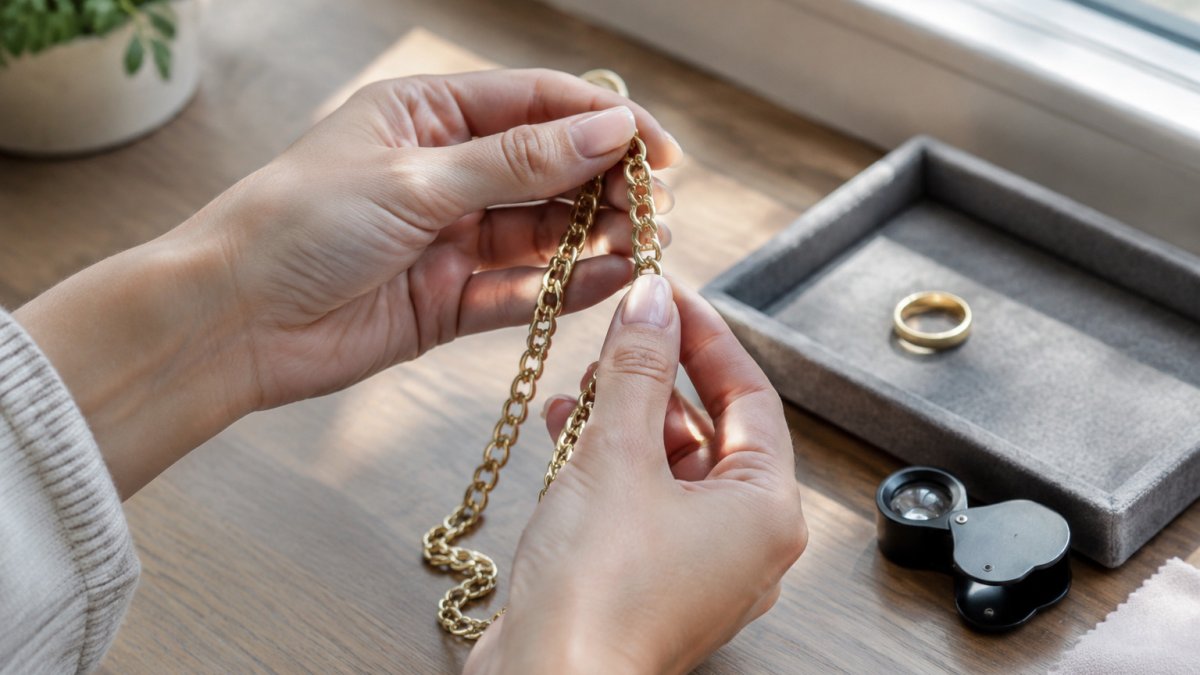
Photograph the unopened package, the shipping label, and the item in its packaging before you handle it. Then photograph the hallmark, the clasp, and any tag, and note the date of delivery. This record matters because return windows and marketplace claims are time-limited, and a seller may argue the item was damaged or swapped after delivery. Keep the piece unworn and in its original condition until you decide to keep it.
Run a visual and stamp check
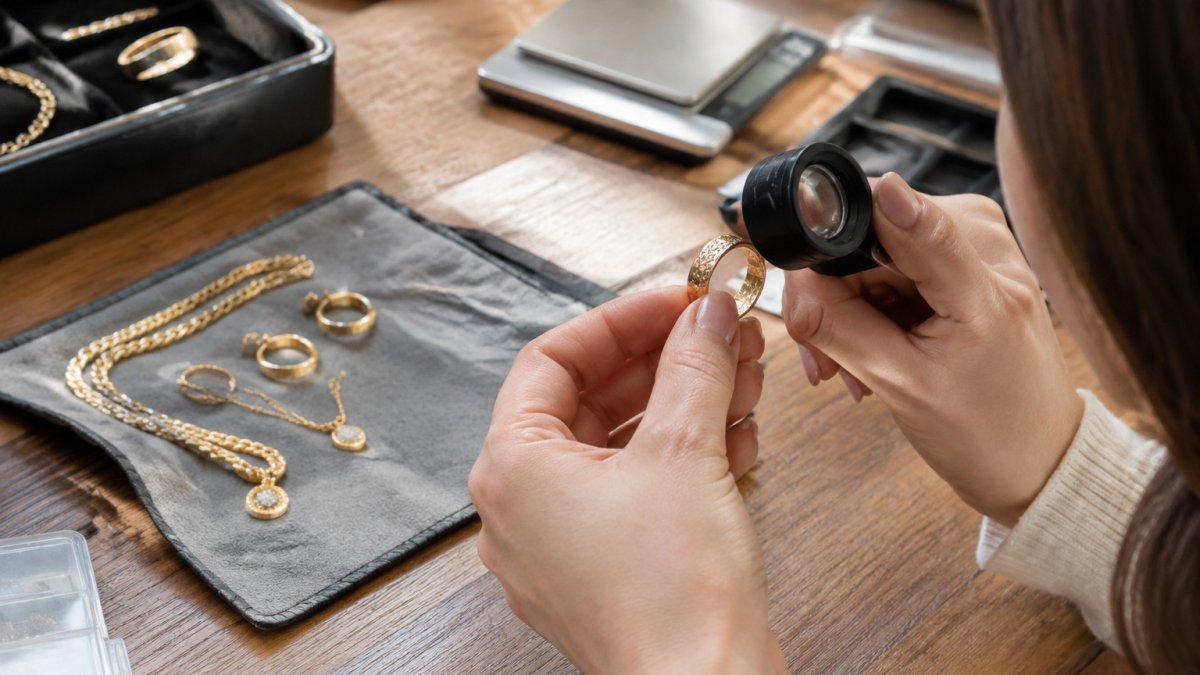
Look for a crisp hallmark on the clasp, bail, or inside the band, consistent finish, and even wear at high-friction points. A blurry or shallow stamp, a stamp only on the packaging, or a finish that looks painted rather than metallic are warning signs. Compare what you see against the listing photos and the stated karat. If the stamp is missing or does not match the listing, stop and contact the seller before doing anything else.
Use home tests only as screening tools
These tests can flag obvious fakes, but none of them establishes gold purity:
- Magnet test: Gold is not magnetic. A strong magnet that pulls the piece suggests iron or steel, but many fakes are non-magnetic, so a pass proves little.
- Water or density test: Gold is dense, but most alloys and base metals sink too, so the result is unreliable without a precise scale and volume measurement.
- Scratch or ceramic test: Rubbing the piece on unglazed ceramic can leave a gold streak for gold and a dark mark for some plated items. The scratch is permanent, so test only an inconspicuous spot, and accept that the result is suggestive, not conclusive.
Do not use acid tests at home. They can burn skin, damage the piece, and void a return. A magnet or visual check cannot establish karat or detect thick gold plating over a dense base metal, which is why a professional check is the only reliable confirmation.
Arrange independent testing within the return window
If the piece is expensive or the stamp is unclear, take it to a local jeweler and ask for an X-ray fluorescence (XRF) reading or a written appraisal. XRF is non-destructive and measures metal composition without harming the item (X-ray Methods for Chemical Imaging at Micro to Mesoscales | NIST).
Home tests can screen for obvious fakes, but none of them confirms gold purity, so the article lays out what each one can and cannot show.
| Test | What it can show | Limitation |
|---|---|---|
| Magnet test | Strong pull suggests iron or steel | Many fakes are non-magnetic, so a pass proves little |
| Water or density test | Rough density clue | Most alloys and base metals sink too; needs precise scale |
| Scratch or ceramic test | Gold streak versus dark mark | Permanent mark; suggestive, not conclusive |
| Acid test | Not recommended at home | Can burn skin, damage the piece, and void a return |
| Visual and stamp check | Crisp hallmark matching the listing | Hallmarks can be faked; compare against listing |
| Professional XRF reading | Measures metal composition without harm | Needs a jeweler; schedule within the return window |
How Jewelers Test Gold and When to Ask for a Professional Check
Jewelers use methods such as X-ray fluorescence (XRF) analyzers. These are non-destructive tools that measure the metal composition without harming the piece. Many local jewelers will test a piece for a small fee, and some will do it free of charge.
Consider a professional check when:
- The piece is expensive or has sentimental value
- The stamp is unclear or missing
- The listing and the piece in hand do not match
- A dispute with the seller is under way
Ask for a written appraisal or test result. It gives you documentation for returns or claims.
Your Next Step: Ordering a Piece You Can Verify Yourself
The safest way to buy gold online is to choose pieces with clear, honest listings and back them with a clear return policy.
Browse our everyday gold collection. Our 14K Gold Filled PLUS™ Figaro Chain Necklace, priced at $31.99, pairs well with finer chains, and the 14K Gold Filled PLUS™ Herringbone Chain Necklace at $39.99 offers a flat, mirror-polished look.

Frequently Asked Questions
How can I test at home if my jewelry is real gold?
Start with the hallmark or karat stamp, then use a magnet test: real gold is not magnetic, so a strong pull suggests a base metal or plated piece. A water or density test can also help, but results are not conclusive on their own. Home tests can damage plating and cannot confirm purity with certainty, so treat them as a first screen. If the piece is valuable, a jeweler using an X-ray fluorescence analyzer can measure its metal composition without harming it.
Can a ring be real gold if it is not stamped?
Yes, but an unstamped piece is harder to verify. Some genuine gold items are too small for a stamp, and some older or handmade pieces were never marked. Without a hallmark, ask the seller for documentation such as an appraisal or a certificate of authenticity, and consider having a jeweler test the metal before you rely on it. A missing stamp is a reason to ask questions, not proof that the item is fake.
What does a 14K or 18K gold stamp mean?
A karat stamp indicates the proportion of gold in the alloy, with higher karats containing more gold. The remainder is alloy metals such as copper or silver, which add strength and affect color. Higher karat means more gold, but also softer metal that scratches more easily. A karat stamp describes purity only; it does not confirm that the item is solid gold rather than gold-plated or gold-filled.
Will a jeweler test gold jewelry after it arrives?
Many independent jewelers will test gold for a fee, and some will do it at no charge if you are considering a purchase. Ask in advance about the method they use, whether the test is non-destructive, and whether they will provide a written report. Keep the original packaging and receipt in case the test result differs from the listing, since that evidence supports a return or dispute.